
Why is my ceiling leaking after a storm in Dallas
A ceiling leaking after a storm in Dallas almost always traces back to failed flashing, lifted shingles, or clogged gutters. Here is how to find it and stop it fast.
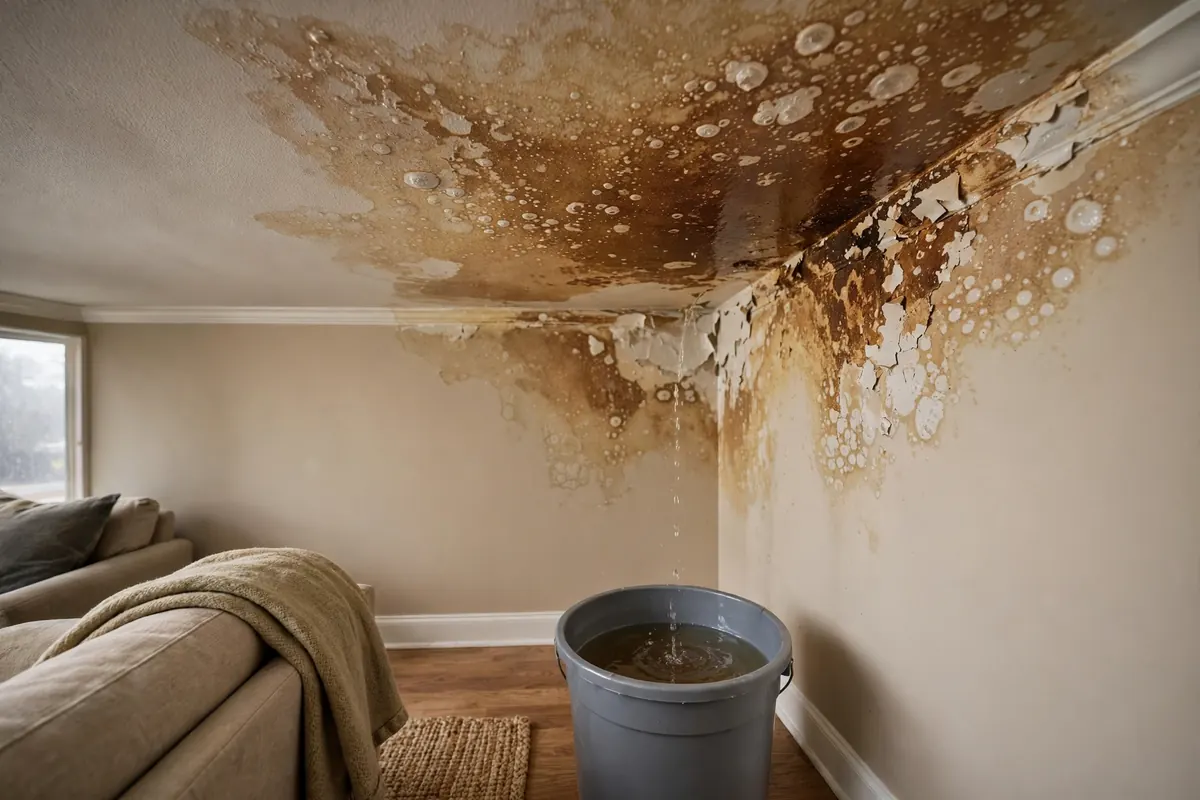
A ceiling leak after a Dallas storm almost always traces back to failed flashing, lifted shingles, or clogged gutters — and the entry point is rarely directly above the stain. Water runs downhill along the decking and the rafters before it finds a way through the ceiling, so the stain marks where the water arrived, not where it got in. This guide explains the usual causes, what to do right now, and how a roofer traces the leak to its source.
The quick answer: a ceiling leaking after a storm in Dallas
A ceiling leak after a Dallas storm almost always traces back to failed flashing, lifted shingles or clogged gutters — and the entry point is rarely directly above the stain. Find the source in the attic and on the roof, stop the water, then repair the failed detail.
Why a ceiling leak shows up after a Dallas storm
Dallas storms attack a roof in combination: wind drives rain sideways under shingles, hail bruises the covering, and heavy rain overwhelms gutters. A roof that was already weakened — flashing sealant dried out by summer heat, a shingle tab lifted by an earlier wind, a valley full of debris — lets water in at the weak point, and the water runs along the decking until it finds a seam or a nail hole in the ceiling below. That is why a leak often appears hours after the rain stops, and why it can appear in a room far from the damaged slope. Dallas County has recorded 842 hail events from 1955 through 2026, and the storms that cause most ceiling leaks are the spring and summer cells that combine hail, wind and heavy rain in a single afternoon. Heat plays a part too: roof surfaces reach 150 to 170 degrees in summer, which dries out sealant and makes shingles brittle, so the next storm finds a roof already weakened.
How to stop the leak right now
Move furniture and anything that cannot get wet away from the leak, and put a bucket under the drip. If the ceiling is bulging or sagging, do not poke it — a bulging ceiling is holding water, and puncturing it can bring the whole section down. If water is near light fixtures or outlets, turn off power to that room at the breaker. Then, if you can reach the attic safely, place a bin under the drip and photograph the stain and the decking above it — the stain's path is the clue the roofer uses. Do not climb on the roof in the rain or in the dark. The emergency step is a tarp, applied by a roofer once conditions allow, and the permanent repair follows an inspection. Read our emergency roof repair guide for the full first-steps order.
What the leak is telling you about your roof
The location and the pattern of the leak say a lot about the cause. A leak near a chimney, skylight or wall usually means failed flashing — the most common leak source in Dallas homes, and the one most often done badly. A leak along a valley line points to valley flashing or debris. A leak that appears only in heavy wind-driven rain points to lifted shingles or a failed seal at a ridge or edge. A leak that shows up after every rain, even light rain, points to a hole or a failed penetration — a pipe boot or vent whose rubber seal has dried out in the heat. A leak with no clear pattern, or one that appears in several places, points to a roof that is failing as a system rather than at one detail, and that is the point where a repair or replacement decision needs a professional inspection. Our leak detection and repair in Dallas page explains how the source is traced.
What affects storm roof leak repair cost in Dallas
Leak repair pricing follows the source, not the stain. A failed pipe boot is a different job from a chimney flashing rebuild, and a valley rebuild is a different job again. What moves the number is the location of the entry point, the material involved, the pitch and height of the roof, and what is found underneath — wet or rotted decking grows the scope. A leak that has been running for a while also means damaged insulation and possibly damaged drywall, which is a separate repair. This business publishes no price list. What you should get before any permanent work starts is a written scope that names the entry point, what is included, and whether a permit is needed — Dallas requires a permit before any new roof covering is applied.
Does insurance cover ceiling leaks from storms in Dallas?
Most Dallas homeowners policies cover sudden damage from hail, wind and storms, but they do not cover wear and tear or lack of maintenance. Whether a ceiling leak is covered, and how much is paid, depends on the policy terms — in particular whether the policy pays replacement cost or actual cash value, which subtracts depreciation and pays less as the roof ages. Get a professional inspection and written documentation of the damage before talking to your insurer, so the conversation is about a documented problem. A roofer documents damage; the insurer decides coverage. Texas law bars a contractor doing the work from negotiating the claim, so a roofer should never promise to handle it for you.
Common mistakes to avoid
- Painting over the stain. The stain is a symptom, not the problem. The leak is still there, and the next storm will bring it back.
- Poking a bulging ceiling. A bulging ceiling is holding water. Let a professional deal with it.
- Assuming the leak is above the stain. Water runs downhill along the decking. The entry point is usually above and to one side of the stain.
- Waiting for the next storm to confirm it. A small leak becomes a stained ceiling, then a sagging ceiling, then damaged insulation and framing.
- Talking to the insurer before an inspection. Get the inspection and the documentation first.
When to call a professional
Call a roofer the moment you see a ceiling stain after a storm — and call before the next rain if you can. A professional roof inspection in Dallas traces the stain to its entry point, checks the flashing and penetrations, and gives you a written scope. If the leak is active, the first step is a tarp to stop the water; the permanent repair follows once the roof can be inspected properly. Homes in Lakewood, the M-Streets and Oak Cliff with older roofs are the ones that most often need the full inspection, because period homes hide leaks well.
Frequently Asked Questions
Why is my ceiling leaking after a storm in Dallas?
It usually traces to failed flashing, lifted shingles, or clogged gutters. Water runs downhill along the decking before it finds a way through the ceiling, so the entry point is rarely directly above the stain.
How do I stop a ceiling leak in Dallas TX?
Move belongings away, put a bucket under the drip, and do not poke a bulging ceiling. Turn off power to the room if water is near fixtures. Then call a roofer — the emergency step is a tarp, followed by an inspection and a written scope.
Does insurance cover ceiling leaks from storms in Dallas?
Most policies cover sudden damage from hail, wind and storms, but not wear and tear. Replacement-cost and actual-cash-value terms affect the payout. Get an inspection and documentation first, then talk to your insurer.
Who fixes roof leaks in Dallas Texas?
Fonseca Brothers Roofing & Remodeling traces ceiling stains to their entry point, checks flashing and penetrations, and gives a written scope. Call (469) 960-7533 — open 24 hours.
How long does storm roof leak repair take?
Most single-issue leak repairs finish within a day once a crew is on the roof. Larger scopes take longer, and weather can delay work. If water is coming in, a tarp goes on first while the permanent repair is scheduled.
Get help with Roofing in Dallas
If your ceiling is leaking after a storm, do not wait for the next one. Call Fonseca Brothers Roofing & Remodeling at (469) 960-7533 — open 24 hours — and we will find the source and stop the water.
Sources
Sources for the facts in this guide: